Average cat weight: healthy weight checker and charts
The average cat weight for a domestic moggy in the UK is about 4 to 4.5 kg. Most females weigh 3.3 to 4.5 kg and most males 4 to 5.5 kg, but breed matters: a healthy Maine Coon can weigh twice as much as a Siamese. Enter your cat's breed, sex, weight and body shape to see whether they're in a healthy range.
Check your cat's weight
Body condition (the 9-point scale vets use) tells you more than the scales alone.
Healthy range for this cat
4.5–5.5 kg
Healthy weightQuick answer
- Average domestic cat: 4–4.5 kg; females 3.3–4.5 kg, males 4–5.5 kg.
- Large breeds like Maine Coons can healthily weigh up to 9 kg.
- Use body condition: ribs easy to feel, a visible waist and no sagging belly.
- Kittens gain roughly 450 g a month until about 5 months.
Average cat weight by breed
These are typical healthy adult weight ranges used by our checker. Individual cats can be healthy slightly outside them, which is why body condition matters too.
| Breed | Female (kg) | Male (kg) |
|---|---|---|
| Domestic moggy (short or long hair) | 3.3–4.5 | 4–5.5 |
| Abyssinian | 3–4 | 3.5–5 |
| Bengal | 3.6–5.4 | 4.5–6.8 |
| Birman | 3.5–5 | 4.5–6.5 |
| British Shorthair | 4–5.5 | 5–7.5 |
| Burmese | 3–4.5 | 4–5.5 |
| Devon Rex | 2.5–3.5 | 3.5–4.5 |
| Maine Coon | 5.5–7 | 6.5–9 |
| Norwegian Forest | 4–6 | 5.5–8 |
| Oriental Shorthair | 2.5–4 | 3.5–5.5 |
| Persian | 3.2–4.5 | 4–5.5 |
| Ragdoll | 4.5–6.5 | 6–9 |
| Russian Blue | 3–4 | 4–5.5 |
| Siamese | 2.5–4 | 3.5–5 |
| Siberian | 4–6 | 5.5–8 |
| Sphynx | 3–4 | 3.5–5.5 |
Normal cat weight in kg: what's healthy?
Average cat weight for females
3.3–4.5 kg for a typical domestic cat.
Average cat weight for males
4–5.5 kg; males usually have larger frames.
Small breeds
2.5–4 kg: Siamese, Devon Rex, Oriental and Singapura.
Large breeds
5.5–9 kg: Maine Coon, Ragdoll, Norwegian Forest and Siberian males.
Neutered cats often gain weight because their energy needs drop by around a quarter while their appetite stays the same. Recent PDSA research suggests that a large share of UK cats are overweight, and many owners don't realise it.
Kitten weight chart
| Kitten's age | Typical weight |
|---|---|
| Birth | 90–110 g |
| 1 week | 150–200 g |
| 2 weeks | 200–300 g |
| 3 weeks | 300–400 g |
| 4 weeks | 400–500 g |
| 6 weeks | 600–800 g |
| 8 weeks | 0.9–1.1 kg |
| 3 months | 1.3–1.8 kg |
| 4 months | 1.8–2.3 kg |
| 5 months | 2–2.7 kg |
| 6 months | 2.3–3.2 kg |
| 9 months | 2.8–4 kg |
| 12 months | 3–4.5 kg (large breeds keep growing) |
A simple rule of thumb: healthy kittens gain about 10–15 g a day in the first weeks, and roughly 450 g a month until about 5 months. Weigh young kittens daily if they're being hand-reared or fostered. A kitten that stops gaining weight or loses weight needs a vet check the same day. See our guide to fostering a cat for caring for young kittens.
Ideal cat weight: body condition score
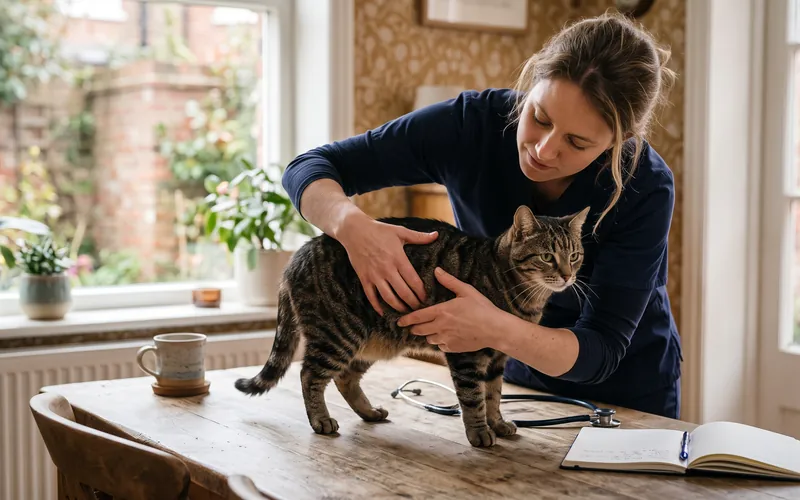
Vets use a 9-point body condition score (BCS), where 5 is ideal. Each point above 5 is about 10% overweight.
| Score | What you see and feel |
|---|---|
| 1–3: Underweight | Ribs, spine and hip bones easy to see; little or no fat; obvious waist |
| 4: Slim | Ribs easy to feel with minimal fat; clear waist |
| 5: Ideal | Ribs felt with light pressure; visible waist; small belly fat pad |
| 6–7: Overweight | Ribs harder to feel; waist faint or absent; belly pouch |
| 8–9: Obese | Ribs can't be felt; heavy fat over chest, spine and belly; rounded body |
How to check your cat's weight by feel
- Ribs: run your hands along your cat's sides. You should feel the ribs easily, like the back of your hand.
- Waist: look down from above. There should be a slight inward curve behind the ribs.
- Belly: look from the side. A small, loose fat pad (the "primordial pouch") is normal, but a large, firm, rounded belly isn't.
Is my cat overweight?
Excess weight raises the risk of diabetes, arthritis, urinary problems, skin issues from difficulty grooming, and a shorter life. If your cat is overweight:
- Measure food accurately with our cat food calculator, using the target weight.
- Cut treats to under 10% of daily calories.
- Encourage play for 10 to 15 minutes, two or three times a day.
- Use puzzle feeders to slow eating.
- Aim to lose 1 to 2% of body weight a week, and ask your vet about a weight clinic.
Never starve a cat to make it lose weight. Cats that stop eating can develop fatty liver disease within days. Slow, steady weight loss is safest.
Is my cat underweight?
A cat that's too thin or losing weight without a diet should see a vet. Common causes include hyperthyroidism (see Thyronorm for cats), kidney disease (see renal diets), diabetes, dental pain (see our cat dental chart), worms (see cat worming) and stress. Older cats naturally lose some muscle, but steady weight loss isn't normal at any age.
Cat weight by age
Most cats reach adult weight by 12 to 18 months, but large and slow-maturing breeds keep growing for longer: up to 3 to 5 years in Maine Coons, and about 3 years in British Shorthairs. Weight often creeps up between ages 3 and 10, especially after neutering, then may fall in senior years. Weighing your cat monthly and comparing with the healthy range is the best way to catch changes early. See what your cat's age means in human years with our cat years calculator.
FAQs
What is the average weight of a cat in kg?
The average domestic cat in the UK weighs around 4 to 4.5 kg. Females typically weigh 3.3 to 4.5 kg and males 4 to 5.5 kg. Pedigree breeds vary widely, from about 2.5 kg for a small Siamese or Devon Rex to 9 kg for a large male Maine Coon.
What is the ideal weight for a cat?
A cat's ideal weight depends on its frame and breed, so it's best judged by body condition. At an ideal weight, you can feel the ribs under a thin layer of fat, see a waist behind the ribs from above, and there's no large sagging belly.
Is a 6 kg cat overweight?
For an average domestic moggy, 6 kg is usually overweight. For a large male Maine Coon, Norwegian Forest Cat, Siberian, Ragdoll or British Shorthair, it can be perfectly healthy. Check body condition and ask your vet.
How much should a kitten weigh?
Kittens weigh about 90 to 110 g at birth and should roughly double that within 7 to 10 days. At 8 weeks they usually weigh 0.9 to 1.1 kg, at 4 months about 1.8 to 2.3 kg and at 6 months about 2.3 to 3.2 kg.
How do I weigh my cat at home?
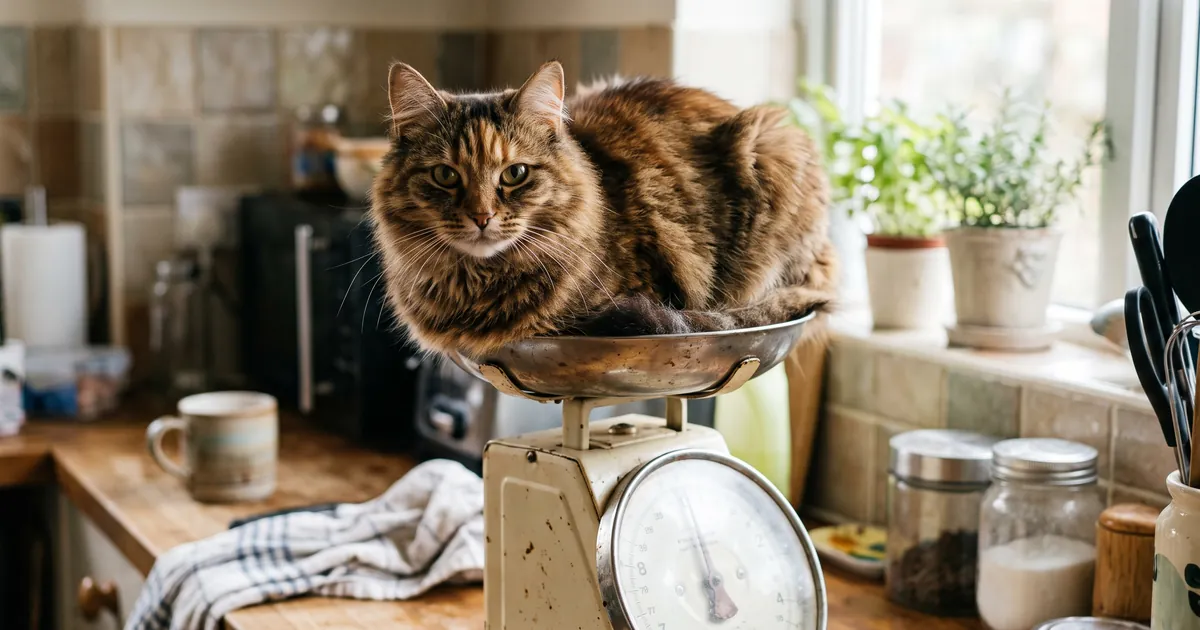
Weigh yourself on bathroom scales, then weigh yourself holding your cat and subtract the difference. For more accuracy, use baby scales or kitchen scales with a cat carrier, or ask your vet practice, which may offer free weight checks.
Why is my cat losing weight?
Unexplained weight loss in cats can be a sign of hyperthyroidism, diabetes, kidney disease, dental pain, worms or other illness, especially in older cats. Book a vet appointment if your cat loses weight without a diet.
Sources and further reading
This guide is for general information only and is not a substitute for advice from a vet. Medicines, doses and costs change: always follow your vet and the product leaflet. If your cat is unwell or you think it has eaten something toxic, contact your vet or an emergency vet straight away.
Related cat care guides
 Life Stages
Cat in heat
How to tell if your cat is in heat, whether cats bleed, how long heat lasts, male cats, spaying and calming tips. Life Stages
Cat pregnancy calculator
Work out your cat's due date, follow a week-by-week pregnancy timeline and learn the early signs and tests. Life Stages
How much to feed a cat
Calculate how many pouches or sachets a day, grams of dry food or a mix, based on your cat's weight and life stage. Life Stages
Cat years calculator
Convert your cat's age to human years, with a full 1–25 year chart and the life stages vets use. Cat Breeds