Cat pregnancy calculator: due date, signs and week-by-week guide
Enter the date your cat mated and our free cat pregnancy calculator will estimate when her kittens are due. Cats are pregnant for about 63 to 67 days (roughly 9 weeks), and kittens can safely arrive anywhere from day 61 to day 69.
When did your cat mate?
Not sure? Use the first day you think she could have mated. Cats are pregnant for about 63–67 days, and kittens can safely arrive between day 61 and day 69.
Kittens are due around
—
Quick answer
- Cat pregnancy lasts about 63–67 days; the normal range is 61–69 days.
- The first clear sign is pinking up: pink, swollen nipples at around 3 weeks.
- Human pregnancy tests don't work on cats; vets use ultrasound, palpation, blood tests or X-ray.
- Call your vet if there's no labour by day 70 or she strains for 30 minutes without a kitten.
How long is cat pregnancy?
Average length
63–67 days from mating, about 9 weeks. Our calculator uses day 65 as the most likely due date.
Normal window
Kittens born between day 61 and day 69 are usually fully developed and healthy.
When to worry
No labour by day 70, or green or bloody discharge before any kitten arrives: call your vet.
Unlike people, cats are "induced ovulators": they release eggs when they mate, so the mating date is a reliable starting point. If your cat was with an unneutered male for several days, use the first day; the real due date may be a few days later.
Cat pregnancy week by week
| Week | Days | What's happening |
|---|---|---|
| Week 1 | 0–7 | Mating and fertilisation. No visible signs. Heat behaviour stops within a few days. |
| Week 2 | 8–14 | Embryos implant in the womb at about days 10–14. |
| Week 3 | 15–21 | Ultrasound can detect pregnancy from about day 16. "Pinking up" begins at days 18–21. |
| Week 4 | 22–28 | A vet may feel kittens as small lumps. Some cats have mild morning sickness. |
| Week 5 | 29–35 | Belly becomes visibly rounder. Appetite increases; start feeding kitten food. |
| Week 6 | 36–42 | Rapid kitten growth. An X-ray can count kittens from about day 42. |
| Week 7 | 43–49 | Kittens can be felt and seen moving. Belly is large and firm. |
| Week 8 | 50–56 | She grooms her belly more and may start looking for a nest. |
| Week 9 | 57–63+ | Nesting, restlessness, milk may appear. Labour usually follows within days. |
Switch the calculator to "Week by week" to see these milestones as dates for your own cat.
Early signs of cat pregnancy
- No more heat cycles: calling, rolling and restlessness stop. See our guide to a cat in heat.
- Pinking up: nipples become pinker, larger and more noticeable at about 3 weeks.
- Bigger appetite: she may eat noticeably more from week 4 or 5.
- Weight gain: a pregnant cat usually gains 1 to 2 kg overall.
- Morning sickness: occasional vomiting in weeks 3 to 4, though not all cats show this.
- Behaviour changes: more affectionate, more sleepy, or sometimes less tolerant of other pets.
Frequent vomiting, not eating for more than a day, lethargy or a swollen belly without other pregnancy signs aren't normal. These can be signs of illness, so see your vet rather than assuming pregnancy.
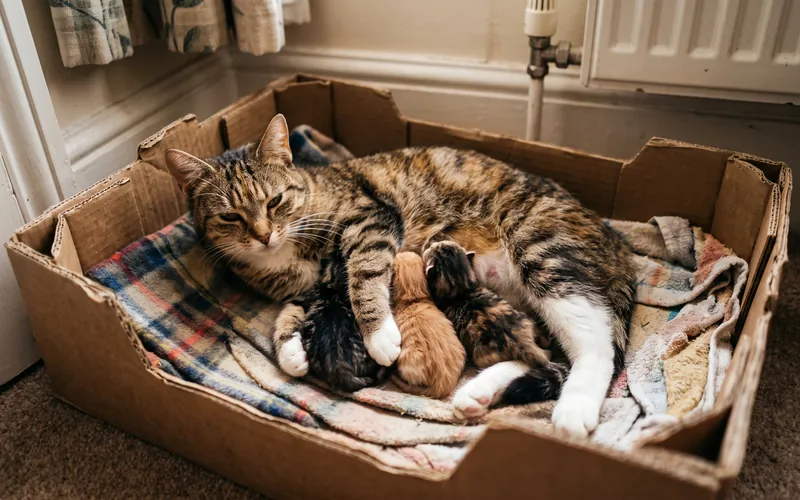
How can you tell if a cat is pregnant?
Cat pregnancy test options
| Test | From about | What it shows |
|---|---|---|
| Ultrasound scan | Day 16–25 | Confirms pregnancy and kittens' heartbeats |
| Palpation by a vet | Day 21–28 | Kittens felt as small, evenly spaced lumps |
| Relaxin blood test | Day 20–25 | Detects a pregnancy hormone produced by the placenta |
| X-ray | Day 42+ | Counts kittens and checks their size before birth |
Human pregnancy tests from the chemist detect a human hormone (hCG), so they won't give a meaningful result for a cat. Don't press on your cat's belly to feel for kittens yourself, as this can harm the pregnancy.
False pregnancy in cats
A false or phantom pregnancy can happen when a cat ovulates after mating (often with a neutered or infertile male) but doesn't conceive. Signs are usually mild: a little weight gain, slightly enlarged nipples, and sometimes nesting. It typically lasts about 30 to 45 days, after which she comes back into heat. False pregnancy is much rarer and milder in cats than in dogs and rarely needs treatment, but a vet scan can tell a real pregnancy from a false one.
Caring for a pregnant cat
Feeding
Switch gradually to a good kitten food from about week 4 or 5 and offer small, frequent meals. Her needs rise by up to 50% by late pregnancy. See our cat food calculator.
Fleas and worms
Use only products licensed for pregnant cats, and ask your vet. Kittens can pick up worms through milk; see cat worming.
Vaccinations and medicines
Don't give vaccines or medicines during pregnancy without vet advice.
Keep her indoors
In the last 2 weeks, keep her inside so she doesn't give birth somewhere unsafe.
Nesting box
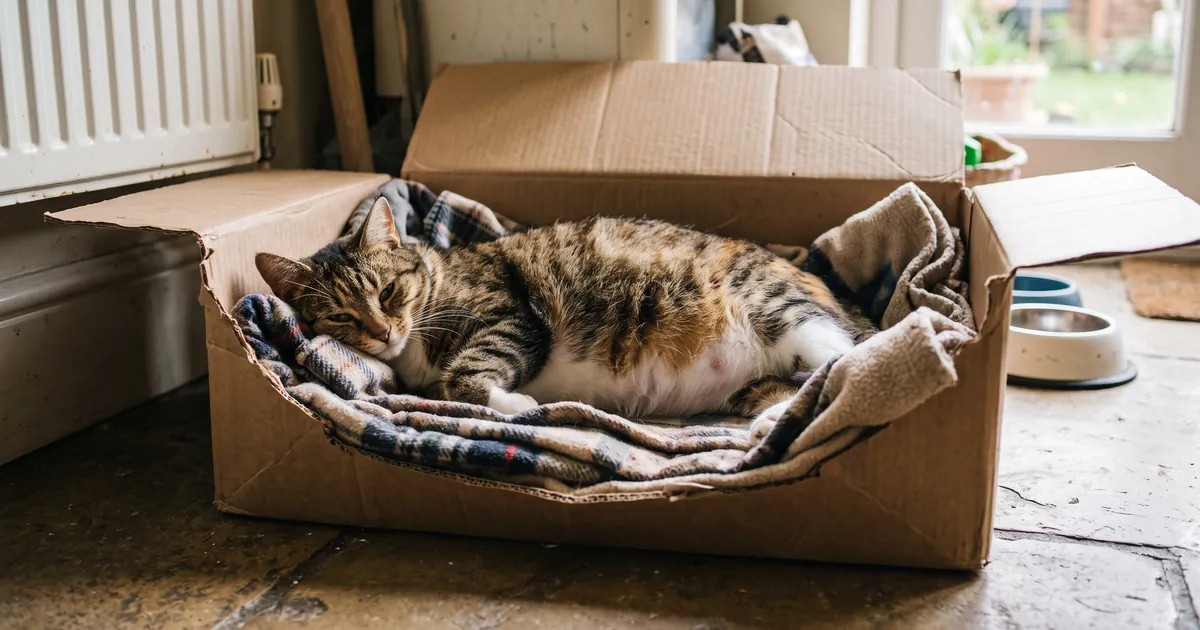
Prepare a box lined with towels or newspaper in a quiet, warm room a week or two before the due date.
Vet check
Book a check-up to confirm pregnancy and discuss what's normal during birth.
Signs of labour in cats
- Stage 1 (6–12 hours, can be up to 36): restlessness, nesting, panting, purring, licking her vulva and refusing food. Her temperature may drop slightly about 24 hours before birth.
- Stage 2 (birth): visible straining. Each kitten usually arrives within 10 to 60 minutes, often in its sac, which the mother tears and licks.
- Stage 3: the placenta follows each kitten. The mother may eat it, which is normal.
Some cats pause for up to 24 hours between kittens (called interrupted labour), resting and feeding the first kittens before delivering the rest. This can be normal if she's calm and not straining.
When to call the vet during cat pregnancy or birth
- Strong straining for 20 to 30 minutes without a kitten.
- More than 1 hour between kittens while she's still straining.
- A kitten stuck in the birth canal for more than a few minutes.
- Green, black or bloody discharge before the first kitten.
- No labour by day 70, or your cat seems weak, collapses or is in obvious pain.
After the kittens arrive
Leave the mother and kittens somewhere quiet and warm, with food, water and a litter tray nearby. Kittens should feed within the first few hours and gain weight daily. Mother cats can come back into heat within a few weeks of giving birth, so plan neutering once the kittens are weaned. Many UK charities offer low-cost or free cat neutering. Kittens can go to new homes at 8 to 9 weeks at the earliest, with 12 to 13 weeks recommended for pedigrees.
Unplanned cat pregnancy
Cats can get pregnant from about 4 months old, and an unneutered female cat can have up to 3 litters a year. Most UK vets and charities now recommend neutering at 4 months, before the first season. If your young cat is already pregnant, talk to your vet about your options and about rehoming the kittens responsibly through a rescue. If you're caring for a pregnant stray, see how to know if a cat is a stray and contact a local rescue; many will help with pregnant cats or arrange foster care.
FAQs
How long is a cat pregnant?
Cats are pregnant for about 63 to 67 days, or around 9 weeks, from mating. Kittens born from day 61 to day 69 are usually healthy. If your cat hasn't gone into labour by day 70, call your vet.
What are the early signs of cat pregnancy?
Early signs include no longer coming into heat, pink and enlarged nipples (pinking up) at about 3 weeks, a bigger appetite, slight weight gain, and sometimes mild morning sickness. Some cats become more affectionate.
Can you use a pregnancy test on a cat?
Human pregnancy tests don't work on cats because they detect a human hormone. Your vet can confirm cat pregnancy with ultrasound from about day 16, gentle palpation from about day 21, a relaxin blood test from about day 20 to 25, or an X-ray from about day 42.
How can you tell how far along a pregnant cat is?
A vet can estimate how far along your cat is with ultrasound, which measures the kittens, or an X-ray after day 42, when kittens' skeletons are visible. Signs at home include pinking up at 3 weeks, a visibly round belly at 5 weeks, and nesting in the final week.
What is a false pregnancy in cats?
A false (phantom) pregnancy happens when a cat ovulates but doesn't conceive. She may show mild pregnancy signs, such as weight gain or enlarged nipples, for around 30 to 45 days before returning to heat. It's much less common in cats than in dogs.
How many kittens do cats have?
Most litters have 4 to 6 kittens, although litters of 1 to 10 or more are possible. First-time mothers and older cats often have smaller litters.
Sources and further reading
This guide is for general information only and is not a substitute for advice from a vet. Medicines, doses and costs change: always follow your vet and the product leaflet. If your cat is unwell or you think it has eaten something toxic, contact your vet or an emergency vet straight away.
Related cat care guides
 Life Stages
Cat years calculator
Convert your cat's age to human years, with a full 1–25 year chart and the life stages vets use. Life Stages
How much to feed a cat
Calculate how many pouches or sachets a day, grams of dry food or a mix, based on your cat's weight and life stage. Life Stages
Average cat weight
Check your cat's healthy weight in kg by breed and sex, see a kitten weight chart and learn to score body condition. Life Stages
Cat in heat
How to tell if your cat is in heat, whether cats bleed, how long heat lasts, male cats, spaying and calming tips. UK Cat Costs
Free cat neutering in the UK
How Cats Protection, RSPCA, PDSA and Blue Cross neutering vouchers and schemes work, who qualifies and how to apply. UK Cat Costs