Cat eye problems: symptoms, causes and treatment
Cat eye problems range from mild conjunctivitis that clears in a week to painful ulcers and sudden blindness that need urgent treatment. Because eye conditions can get worse quickly, it's important to know which signs to watch for. This guide explains the most common eye problems in cats, what causes them, how vets treat them and how to give eye drops safely.
Quick answer
- Squinting, a closed eye or a cloudy eye usually means pain: see a vet the same day.
- The most common cause of sore, runny eyes is conjunctivitis, often linked to cat flu viruses.
- Never use human eye drops on a cat without a vet's advice: some can make ulcers much worse.
- Sudden blindness or dilated pupils in an older cat can be caused by high blood pressure and is an emergency.
Signs of eye problems in cats
Healthy cat eyes are bright, clear and equally open, with no redness, discharge or visible third eyelid. Contact your vet if you notice any of these signs:
- Squinting or holding an eye closed.
- Discharge: watery, sticky, yellow, green or bloody.
- Redness of the eye or the inside of the eyelids.
- Cloudiness or a blue, white or grey haze.
- The third eyelid showing across the inner corner of the eye.
- Pawing at the eye or rubbing the face on furniture.
- A change in eye colour, new spots, or pupils of different sizes.
- Bumping into things, reluctance to jump, or wide pupils in bright light, which can indicate sight loss.
- Swelling around the eye, or the eye looking larger or bulging.
See a vet urgently if your cat's eye is closed, very cloudy, bulging, injured or bleeding, or if your cat suddenly seems blind. Eye conditions can worsen within hours.
Common cat eye problems
These are the cat eye problems vets in the UK see most often. Several can look similar at home, which is why a vet examination, often with a special dye test, matters.
| Problem | Typical signs | Urgency |
|---|---|---|
| Conjunctivitis | Red, swollen eyelids, discharge, mild squinting | See a vet within 1–2 days |
| Corneal ulcer | Squinting, watering, cloudy patch, pawing at the eye | Same day |
| Corneal sequestrum | Brown or black spot on the eye surface, discomfort | Within a few days |
| Uveitis | Red, cloudy eye, small pupil, light sensitivity | Same day |
| Glaucoma | Enlarged, cloudy, painful eye, dilated pupil | Emergency |
| Cataract | White or cloudy pupil, reduced vision | Routine to soon |
| Third eyelid protrusion (haws) | Pale membrane across inner eye | Within a few days unless unwell |
| Blocked tear duct | Constant watering, tear staining | Routine |
| Iris melanosis | Flat dark spots on the coloured part of the eye | Routine monitoring |
| Retinal detachment (high blood pressure) | Sudden blindness, very dilated pupils | Emergency |
Conjunctivitis in cats
Conjunctivitis is inflammation of the pink tissue lining the eyelids and the white of the eye. It's the most common of all cat eye problems. Signs include redness, swelling, discharge and mild squinting, often in both eyes.
Causes of conjunctivitis
- Feline herpesvirus (FHV-1): the most common cause. Many cats carry the virus for life, and stress can trigger flare-ups. Read about lysine for cats, a supplement sometimes suggested for herpes flare-ups.
- Chlamydia felis and Mycoplasma: bacteria that cause persistent conjunctivitis, especially in multi-cat homes.
- Cat flu: conjunctivitis often comes with sneezing and a runny nose. See our guide to cat cold symptoms.
- Irritants and allergies: dust, smoke, pollen or cleaning products. Read can cats get hayfever.
Cat conjunctivitis eye drops
Treatment depends on the cause. Vets may prescribe antibiotic drops or ointment for bacterial infections, antiviral drops for severe herpes infections, or anti-inflammatory treatment once ulcers have been ruled out. Mild viral conjunctivitis often settles in one to two weeks with gentle cleaning.
Cat cloudy eye
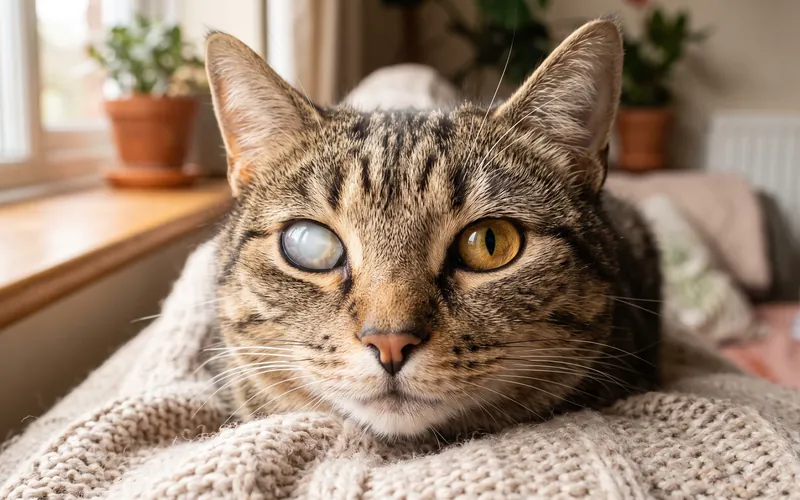
A cloudy eye is one of the most worrying cat eye problems because it can have several serious causes:
- Corneal ulcer or oedema: damage to the clear front of the eye makes it look blue-white or hazy.
- Uveitis: inflammation inside the eye, linked to infections (such as FIV, FeLV, FIP or toxoplasmosis), injury or cancer. The eye may look red and cloudy with a small pupil.
- Glaucoma: raised pressure inside the eye, often following uveitis. The eye may look larger, cloudy and painful.
- Cataract: clouding of the lens, which sits behind the pupil. Cataracts in cats are often caused by previous inflammation or diabetes.
- Lens ageing (nuclear sclerosis): a soft blue-grey haze in older cats, which is normal and doesn't usually affect vision much.
Any new cloudiness needs a vet examination. Uveitis and glaucoma are painful and can cause permanent blindness without prompt treatment.
The squinting cat: corneal ulcers and injuries
A cat that squints or keeps one eye closed is almost always in pain. The most common cause is a corneal ulcer: a scratch or erosion on the clear surface of the eye, often from a fight, a plant, or a herpesvirus flare-up.
How vets diagnose an ulcer
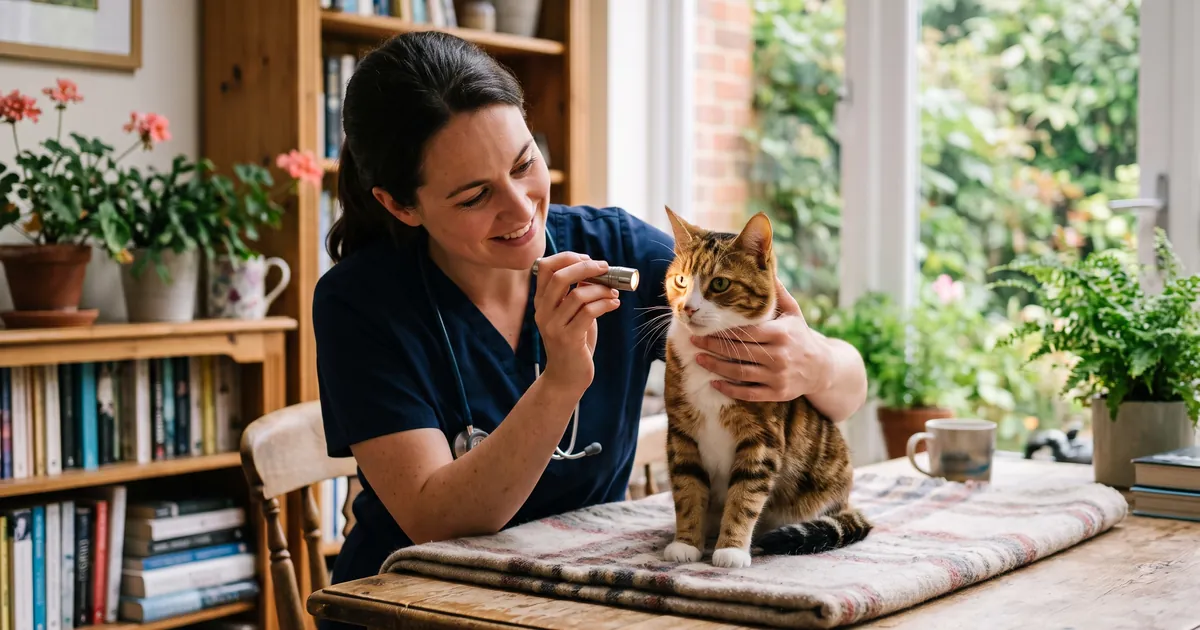
Your vet puts a drop of orange dye (fluorescein) on the eye. Damaged areas of the cornea turn bright green under a blue light. This quick test shows whether there's an ulcer and how deep it is.
Treatment
Ulcers are treated with antibiotic drops to prevent infection and pain relief. Deep or slow-healing ulcers may need a special procedure or surgery. Steroid eye drops must never be used on an ulcerated eye, as they can cause it to deepen and perforate. This is one reason never to use leftover or human eye drops without asking your vet.
Corneal sequestrum in cats
A corneal sequestrum is a brown or black patch of dead tissue on the surface of the eye. It's a cat-specific condition, most common in Persians, Exotics, Himalayans and other flat-faced breeds, and often follows a long-standing ulcer or herpesvirus infection. Small sequestra sometimes slough off by themselves, but many need surgery by a veterinary ophthalmologist. Our guide to the Persian cat explains why flat-faced breeds are prone to eye problems.
Haws syndrome and the third eyelid
Cats have a third eyelid (nictitating membrane), usually hidden in the inner corner of the eye. When it stays partly across the eye, it's called a protruding third eyelid, or "haws".
- Both eyes, cat otherwise well: often "haws syndrome", linked to a mild gut upset or virus. It usually resolves on its own within 4 to 8 weeks.
- One eye only: may indicate pain, a foreign body behind the eyelid, or a nerve problem called Horner's syndrome (sometimes with a small pupil and a droopy eyelid).
- With weight loss, lethargy or dehydration: the third eyelids can show when a cat is generally unwell.
Have your vet check any third eyelid that appears suddenly, especially in one eye only.
Cat blocked tear duct and watery eyes
Tears normally drain through small ducts into the nose. When a duct is narrow or blocked, tears spill over and stain the fur, typically leaving brown marks below the inner corners of the eyes. This is very common in flat-faced breeds. Other causes include scarring from a previous cat flu infection, inward-turning eyelids (entropion) and inflammation. Your vet can flush the ducts or treat the underlying cause. Daily gentle cleaning helps keep the skin healthy.
Iris melanosis in cats
Iris melanosis appears as flat, freckle-like brown or black spots on the coloured part of the eye (the iris), most often in middle-aged and older cats. In many cats the spots stay the same for years, but in some they spread, thicken or change the shape of the pupil, which can signal diffuse iris melanoma, a potentially serious cancer. Ask your vet to photograph or record the spots and recheck them every 6 to 12 months, or sooner if they change.
Sudden blindness: high blood pressure in older cats
High blood pressure (hypertension) is common in older cats, especially those with kidney disease or an overactive thyroid. It can damage the retina and cause sudden blindness, bleeding inside the eye, or very wide pupils that don't shrink in bright light. This is an emergency: prompt treatment to lower blood pressure can sometimes restore some vision. Read about normal cat heart rate and blood pressure and why vets check it yearly in older cats, and see our guides to hyperthyroidism treatment and kidney diets.
Which cat eye problems can wait, and which can't?
Cat eye problems that need a vet today
- An eye that is closed, squinting or being pawed at.
- A cloudy, blue or white eye, especially if it's painful.
- Blood in or around the eye, or an obvious injury.
- An eye that looks bigger than the other or is bulging.
- Sudden blindness, bumping into things, or wide pupils that don't react to light.
- Something visibly stuck in the eye, such as a grass seed.
Cat eye problems that can be checked within a day or two
- Mild redness and clear discharge in a cat that's otherwise eating and playing normally.
- Both third eyelids showing in a cat that seems well.
- Gradual tear staining or watery eyes.
- New flat dark spots on the iris.
If you're unsure, phone your vet practice and describe the signs: the reception team or a vet nurse can tell you how quickly your cat needs to be seen. Out of hours, contact your vet's emergency service rather than waiting until morning for anything on the first list.
Eye drops on cats: how to give them
Giving eye drops is easier with practice and a calm approach:
- Wash your hands and check the label and dose.
- Clean away discharge with cotton wool and cooled boiled water.
- Hold your cat on your lap or wrapped in a towel, facing away from you.
- Tilt the head up gently, holding the chin with one hand.
- Rest the hand holding the bottle on top of your cat's head, so it moves with your cat.
- Drop the medication onto the eye from just above it, without touching the eye with the tip.
- Let your cat blink, then reward with a treat.
For ointment, gently pull down the lower lid and squeeze a thin line inside it. If using more than one type of drop, wait about 5 minutes between them. An eye dropper or a single-dose pipette can be easier for some owners. If you're struggling, ask your vet nurse to show you. Our guide on how to give a cat a pill includes the towel wrap method.
Chloramphenicol eye drops for cats
Chloramphenicol is an antibiotic eye drop or ointment that vets sometimes prescribe for bacterial eye infections. Human chloramphenicol drops are sold in UK pharmacies, which leads some owners to try them on their cats. Please don't do this without speaking to a vet first:
- Many cat eye problems are viral or caused by ulcers, so an antibiotic alone won't help.
- A painful ulcer or uveitis needs prompt diagnosis; delaying can risk the eye.
- Your vet will choose the right drug, dose and duration for your cat.
How to clean your cat's eyes safely
- Use cotton wool or a soft lint-free pad moistened with cooled boiled water.
- Use a fresh piece for each eye to avoid spreading infection.
- Wipe gently from the inner corner outwards.
- Never use cotton buds, tea, salt water or human eye washes unless your vet advises.
- Flat-faced breeds may need daily cleaning to prevent tear staining and skin irritation.
Eye problems linked to other illnesses
Sometimes the eyes are the first place a wider health problem shows. Uveitis can be a sign of infections such as FIV, FeLV, FIP or toxoplasmosis, and retinal changes can reveal high blood pressure from kidney or thyroid disease. Diabetes can lead to cataracts. That's why your vet may recommend blood tests or a blood pressure check when investigating a cloudy or red eye, even if your cat otherwise seems well.
How much does treating cat eye problems cost?
| Item | Typical UK cost |
|---|---|
| Vet consultation | £45–£80 |
| Fluorescein stain test | £10–£30 |
| Eye pressure measurement | £20–£50 |
| Eye drops or ointment | £15–£40 |
| Referral to a veterinary ophthalmologist | £200–£400 for the first appointment |
| Eye surgery (e.g. sequestrum, deep ulcer) | £800–£2,500+ |
Pet insurance usually covers eye conditions that develop after the policy starts. See our guide to cat insurance.
Preventing cat eye problems
- Keep vaccinations up to date to protect against cat flu viruses.
- Reduce stress, which can trigger herpesvirus flare-ups.
- Check your cat's eyes during regular grooming and cuddles.
- Clean tear staining daily in flat-faced breeds.
- Ask for yearly blood pressure checks once your cat is over about 7 to 10 years old.
- Keep toxic and spiky plants away from indoor cats.
Cat eye problems in flat-faced breeds
Persians, Exotic Shorthairs, Himalayans and other flat-faced (brachycephalic) cats have prominent eyes, shallow eye sockets and often narrow tear ducts. As a result, they are more likely to have watery eyes, tear staining, corneal ulcers, corneal sequestrum and eyelid problems. If you own a flat-faced breed, build daily eye cleaning into your routine, check for squinting or cloudiness every day, and see your vet promptly for any change. Choosing kittens from breeders who select for a less extreme face shape can reduce these problems.
Cat eye problems in kittens
Kittens are prone to eye infections, often as part of cat flu. Newborn kittens' eyes open at around 7 to 14 days; if the eyelids look swollen or crusty before or after opening, an infection may be trapped behind them, which needs urgent care to save the eye. Older kittens with sticky, red eyes should see a vet, as infections can spread quickly through a litter and cause lasting damage. Keep kittens warm, wipe their eyes gently and make sure they keep eating.
FAQs
What does it mean when a cat is squinting?
Squinting or holding one eye closed is usually a sign of eye pain. Common causes include a scratch or ulcer on the cornea, conjunctivitis, something stuck in the eye, or inflammation inside the eye. Squinting should be checked by a vet the same day, because ulcers can deepen quickly.
Why is my cat's eye cloudy?
A cloudy eye can be caused by a corneal ulcer, swelling of the cornea, inflammation inside the eye (uveitis), glaucoma, or a cataract. In older cats, a slight blue-grey haze in the lens can be a normal ageing change. Any new cloudiness needs a vet check, as some causes are painful or can lead to blindness.
Can I use chloramphenicol eye drops on my cat?
Only if your vet advises it. Chloramphenicol is an antibiotic that vets sometimes prescribe for bacterial eye infections in cats, but many cat eye problems are caused by viruses or ulcers that need different treatment. Using the wrong drops can delay proper treatment.
What is haws syndrome in cats?
Haws syndrome is when the third eyelids (the pale membranes in the inner corners of the eyes) stay partly across both eyes. In otherwise healthy cats it's often linked to a mild tummy upset and usually resolves by itself within weeks. If only one third eyelid shows, or your cat seems unwell, see a vet.
Are dark spots in my cat's eye dangerous?
Flat brown or black freckles on the iris are called iris melanosis. They're common in older cats and are often harmless, but they can occasionally develop into a type of cancer called diffuse iris melanoma. Ask your vet to record them and check them regularly for growth.
How do I clean my cat's eyes?
Use cotton wool dampened with cooled boiled water, a separate piece for each eye, wiping gently from the inner corner outwards. Don't use cotton buds near the eye. If discharge keeps coming back or is yellow, green or bloody, see your vet.
Sources and further reading
This guide is for general information only and is not a substitute for advice from a vet. Medicines, doses and costs change: always follow your vet and the product leaflet. If your cat is unwell or you think it has eaten something toxic, contact your vet or an emergency vet straight away.