Can cats see in the dark? The science of cat night vision
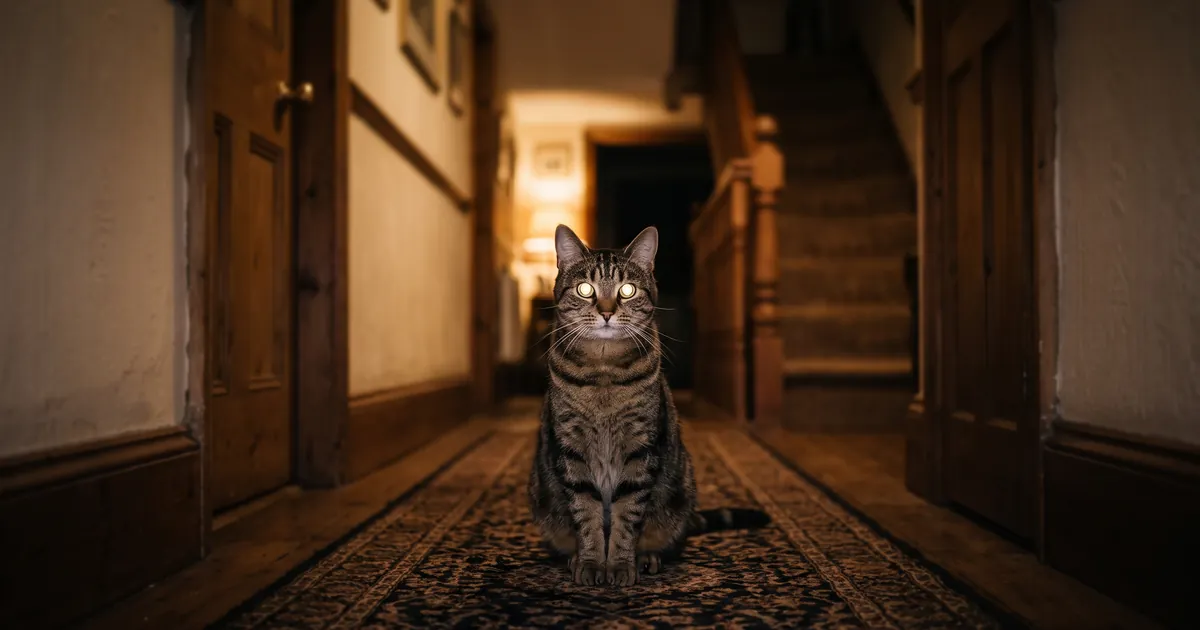
Can cats see in the dark? Almost. Cats can see in light levels about six times lower than people need, which lets them move confidently at dusk, at night and in dim rooms. But in complete darkness, they can't see at all, and rely on their whiskers, hearing and smell instead. Here's how cat night vision works, why cats' eyes glow, and what it means for your cat at home.
Quick answer
- Cats need only about one-sixth of the light people need to see.
- A mirror-like layer behind the retina, the tapetum lucidum, reflects light and makes cats' eyes glow.
- In total darkness, cats can't see; they use whiskers, hearing and smell.
- Cats see movement well but have blurrier vision and fewer colours than us.
Can cats see in the dark? The short answer
Cats can't see in absolute darkness, but they see far better than people in dim light. Their eyes evolved for hunting at dawn and dusk (cats are crepuscular), when small prey such as mice and voles are most active. In practice, there is almost always enough light in a home at night, from street lights, the moon, standby lights and hallways, for a cat to move around confidently.
| Cats | Humans | |
|---|---|---|
| Light needed to see | About one-sixth of human needs | More |
| Reflective layer behind retina | Yes (tapetum lucidum) | No |
| Field of view | About 200° | About 180° |
| Sharpness (detail) | Lower: what we see clearly at 30 m, a cat needs to be about 6 m away | Higher |
| Colour vision | Mainly blues and yellows | Full colour |
| Motion detection in low light | Excellent | Moderate |
| Focus on very close objects | Poor (under about 30 cm) | Good |
How cat night vision works
Large eyes and pupils
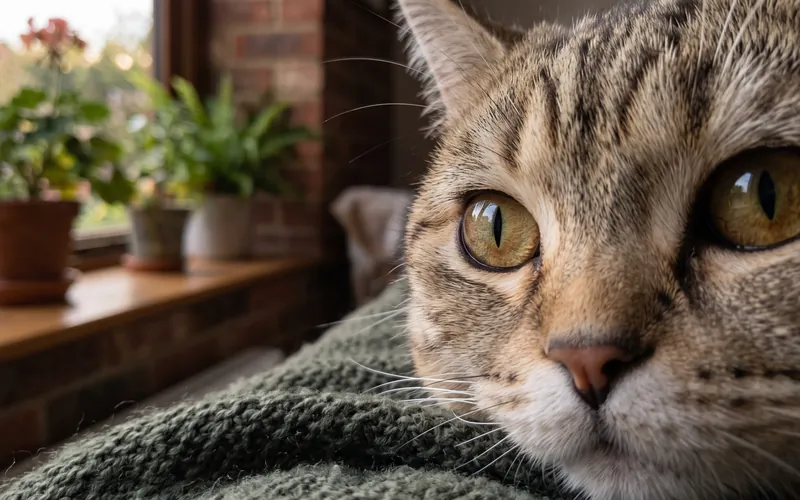
Relative to their head size, cats have very large eyes and corneas. In dim light their pupils can open into wide circles, letting in far more light than a human pupil. Cats' pupils can change size more dramatically than ours, from a thin slit to a near-full circle.
Vertical slit pupils
Many people wonder why cats have slit-shaped pupils. A vertical slit can close down much more tightly than a round pupil, protecting the cat's ultra-sensitive retina in bright sunlight, then open very wide at night. Scientists also think vertical slits help ambush predators that hunt close to the ground judge distances to prey.
More rods, fewer cones
The retina contains two types of light-sensitive cells. Rods detect dim light and movement, while cones detect colour and fine detail. Cats have many more rods than people do and fewer cones. This makes them excellent at seeing in low light and noticing tiny movements, but less good at seeing detail and colour. Read more in our guide to what colours cats can see.
The tapetum lucidum
Behind the retina, cats have a mirror-like layer called the tapetum lucidum (Latin for "bright carpet"). Light that passes through the retina without being detected is reflected back for a second chance. This boosts night vision but scatters light a little, which is one reason cats' vision is slightly blurrier than ours.
Why do cats' eyes glow in the dark?
When light from a torch, car headlights or a camera flash shines into a cat's eyes, the tapetum lucidum reflects it straight back, producing "eyeshine". The colour of the glow, often green, yellow or blue, depends on the minerals in the tapetum and the cat's age and coat colour. Cats with blue eyes, such as many Siamese cats, sometimes have a reddish glow because they have less pigment in the tapetum. See our Siamese cat guide.
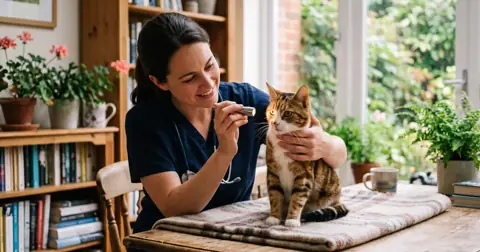
If your cat's eyes look cloudy, reflect light unevenly, or one eye glows differently from the other, mention it to your vet. Our guide to cat eye problems explains when a change in the eyes needs attention.
What cats can't see well
- Total darkness: without any light, cats can't see.
- Fine detail at a distance: cats are slightly short-sighted compared with us.
- Things right under their nose: cats struggle to focus closer than about 30 cm, which is why they sometimes can't find a treat dropped in front of them.
- The full range of colours: cats see mainly blues and yellows, and reds and greens look greyish.
- Still objects in low light: cats are tuned to movement, so a toy that doesn't move is less interesting.
How whiskers help cats in the dark
Whiskers (vibrissae) are thick, deeply rooted hairs packed with nerves. They detect tiny changes in air currents and touch, helping cats:
- Sense objects and walls nearby in the dark.
- Judge whether they can fit through a gap.
- Locate prey right in front of their face, where their eyes can't focus. When hunting, cats push their whiskers forward around the prey.
Never trim a cat's whiskers. Whiskers also make some cats reluctant to eat from narrow, deep bowls ("whisker fatigue" is debated, but wide, shallow bowls are a sensible choice).
Hearing and smell at night
Cats have exceptional hearing, detecting high-pitched sounds well beyond the human range, including the squeaks of mice. Their ears can rotate independently to pinpoint where a sound is coming from. Their sense of smell is many times more sensitive than ours. Together with night vision and whiskers, these senses make cats skilled nighttime hunters. Our guide to whether cats kill rabbits and birds looks at how much UK cats hunt.
Why cats are active at night
Cats aren't truly nocturnal. They're most active around dawn and dusk. Indoor cats often adapt to their owners' routines, but many still have bursts of energy in the evening and early morning, sometimes called the "zoomies" or "midnight crazies". If your cat keeps you awake:
- Play an energetic game with a wand toy in the evening.
- Feed the main meal just before bedtime, as cats often sleep after eating.
- Provide puzzle feeders and toys for the night.
- Don't reward early-morning yowling with food, or it becomes a habit.
Sudden night-time restlessness or yowling in an older cat can be a sign of hyperthyroidism, high blood pressure or cognitive decline, so mention it to your vet. Read about hyperthyroidism treatment.
Should I leave a light on for my cat at night?
For most cats, no. Normal household light at night is plenty. A dim night light can help:
- Senior cats with fading eyesight or cognitive changes.
- Cats with arthritis negotiating stairs or jumping down from beds.
- Newly adopted cats learning their way around a new home. See our guide to keeping a cat in after moving.
- Blind or partially sighted cats, together with keeping furniture in the same place.
Cats outside at night: the risks
Night vision makes cats confident outdoors after dark, but night is when most road accidents involving cats happen, partly because drivers struggle to see them. Wildlife such as foxes and badgers is also more active. Read our guide to whether foxes and badgers attack cats. Many owners keep cats in from dusk to dawn, using a timed cat flap and an evening meal to encourage cats home. Our guide to cat flap installation covers timer and microchip flaps.
Cats vs dogs vs people: who sees best in the dark?
Both cats and dogs have a tapetum lucidum and far more rods than people, so both see much better than us at night. Cats generally have the edge in very low light, thanks to their larger pupils relative to eye size and their extreme pupil range. Dogs tend to have a slightly wider field of view in some breeds and are better at detecting motion at long distances. People win easily on colour vision and fine detail in daylight.
Do cats see in the dark better than owls?
No. Owls are specialist nocturnal hunters with enormous, tube-shaped eyes and outstanding night vision. Cats are dawn-and-dusk hunters, so their eyes balance night vision with reasonable daytime sight.
Can cats see in the dark well enough to watch TV?
Many cats watch birds or moving objects on a screen, especially in a dim room. Because cats detect flicker better than people, older screens with low refresh rates may have looked like a flashing slideshow to them. Modern high-refresh TVs and phones look smoother. Cats respond most to fast, small, darting movements, such as birds, insects and mice, rather than people talking. Screen-watching is a harmless form of enrichment, but it doesn't replace real play.
Why does my cat stare into the dark?
Owners often see their cat staring intently at a dark corner or an empty wall and wonder what it can see. Usually the answer is simple: a cat may be watching a tiny insect, a reflection, a shadow moving outside, or listening to a sound in the wall or ceiling, such as mice or pipes. Cats' sensitive hearing and night vision pick up things we miss. Occasional staring is normal. If an older cat stares blankly, seems confused, or presses its head against walls, see your vet, as this can be linked to high blood pressure, neurological problems or cognitive decline.
Myths about cat night vision
- "Cats can see in total darkness." False: they need some light, although very little.
- "Cats' eyes produce their own light." False: eyeshine is reflected light from the tapetum lucidum.
- "Black cats see better at night." False: coat colour doesn't affect vision, though very pale or blue-eyed cats may have less tapetum pigment.
- "Cats can't see in daylight." False: cats see well in daylight, just with less detail and colour than people.
- "Carrots help cats see in the dark." False: cats can't convert the beta-carotene in carrots into vitamin A, so they need vitamin A from meat in their diet instead.
Playing with your cat in low light
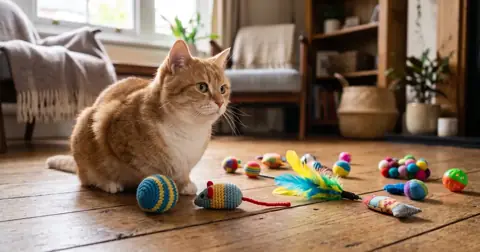
Because cats are wired for dawn and dusk, an evening play session in a dimly lit room often brings out their best hunting behaviour. Use a wand toy and move it like prey: short dashes, pauses and disappearing behind furniture. Avoid laser pointers ending with nothing to catch, as this can frustrate some cats; finish with a toy they can pounce on, or a treat. Play also helps cats sleep through the night.
Night vision in kittens and older cats
Kittens
Kittens are born with closed eyes, which open at about 7 to 14 days. At first all kittens' eyes look blue and their vision is blurry. Sight improves steadily, and by around 3 months old kittens see much like adult cats, including in dim light.
Senior cats
Ageing can bring a hazy lens (nuclear sclerosis), retinal changes and, sometimes, sight loss from high blood pressure. Older cats may hesitate on stairs at night, bump into things or become more vocal in the dark. A vet check, blood pressure test and simple home adjustments can make a big difference. Our guide to cat blood pressure explains why sudden blindness can be an emergency.
Signs your cat's eyesight is getting worse
- Bumping into furniture, especially in dim light or new places.
- Misjudging jumps, or being reluctant to jump.
- Pupils that stay wide open in bright light.
- Startling easily when approached.
- Staying close to walls or moving slowly.
- Eyes that look cloudy, red or different from each other.
Sudden vision loss needs an urgent vet visit. Gradual changes should be checked at your next appointment.
How to test your cat's vision at home
You can't measure your cat's eyesight precisely at home, but a few simple observations help you spot problems early:
- Cotton wool drop: silently drop a cotton wool ball in front of your cat. A sighted cat usually follows it with its eyes. Because cotton wool makes no sound, it tests vision rather than hearing.
- Obstacle check: in a dim room, watch whether your cat moves around confidently or bumps into a new object placed in its usual path.
- Pupil check: in a bright room, both pupils should narrow. Pupils that stay very wide, or are different sizes, need a vet check.
Never shine a bright torch directly into your cat's eyes for long, and see a vet for any concerns.
Helping a cat with poor night vision
- Keep furniture, food, water and litter trays in the same places.
- Use night lights near stairs and litter trays.
- Add ramps or steps to favourite resting places.
- Speak to your cat as you approach, so it isn't startled.
- Consider keeping a partially sighted cat indoors, or provide a secure garden or enclosure.
Cats adapt remarkably well to reduced vision, using their hearing, whiskers and memory to get around.
Diet and night vision: why taurine matters
Cats need a nutrient called taurine to keep the retina healthy. Unlike dogs and people, cats can't make enough taurine themselves, so it must come from their food. Long-term taurine deficiency causes a type of retinal degeneration that leads to blindness, along with heart disease. That was common decades ago, before cat foods were properly balanced.
Today, complete commercial cat foods contain enough taurine, but cats fed dog food, vegetarian diets or unbalanced homemade meals can still become deficient. Our guide to whether cats can eat dog food explains why dog food isn't a safe long-term substitute. Cats also need preformed vitamin A from animal sources, because they can't convert plant beta-carotene, another reason their diet must be based on meat.
Fun facts about cat vision
- Cats blink less than people and can keep their eyes half-closed while still watching you; a slow blink is a friendly signal.
- A cat's third eyelid helps protect and moisten the eye.
- Cats' eyes are among the largest, relative to body size, of any mammal.
- Studies suggest cats can see ultraviolet light, which people can't.
- Cats detect flickering light better than us, so some old fluorescent lights and screens may look jumpy to them.
FAQs
Can house cats see in complete darkness?
No. Cats need at least a little light to see. Their eyes are extremely sensitive, so even faint light from a window, a standby light or the moon is usually enough, but in a completely dark room they rely on their whiskers, hearing and memory of the layout.
How much better can cats see in the dark than humans?
Cats can see in roughly one-sixth of the light humans need. Their large pupils, high number of light-sensitive rod cells and reflective tapetum lucidum all help them see in dim conditions.
Why do cats' eyes glow in the dark?
Behind the retina, cats have a reflective layer called the tapetum lucidum. It bounces light back through the retina for a second chance to detect it, which improves night vision. When light such as a torch or camera flash shines into a cat's eyes, the tapetum reflects it, creating the glow.
Should I leave a light on for my cat at night?
Most cats don't need a light on, because they see well in the low light that usually comes from windows and devices. A dim night light can help older cats with poor eyesight, cats with arthritis navigating stairs, and newly adopted cats learning a new home.
Can cats see better at night than in the day?
Cats are adapted to see best at dawn and dusk, when their prey is active. They can see in daylight too, but their vision is less sharp than ours and they see fewer colours. In very bright light, their pupils narrow to thin slits to protect the sensitive retina.
Do kittens see in the dark?
Kittens are born with their eyes closed. Their eyes open at around 7 to 14 days, but vision is blurry at first and develops over the following weeks. By around 3 months old, a kitten's eyesight, including night vision, is similar to an adult cat's.
Sources and further reading
This guide is for general information only and is not a substitute for advice from a vet. Medicines, doses and costs change: always follow your vet and the product leaflet. If your cat is unwell or you think it has eaten something toxic, contact your vet or an emergency vet straight away.