How to remove cat urine smell (for good)
Knowing how to remove cat urine smell properly matters, because cats return to places that still smell of urine, even faintly. Ordinary cleaners often mask the smell for people but leave uric acid crystals that cats (and humid days) bring back to life. The answer is to blot, rinse and use an enzyme cleaner, then find out why your cat went there in the first place.
Quick answer
- Blot, don't rub: soak up as much urine as possible first.
- Use an enzyme (biological) cleaner that breaks down uric acid, the source of the lasting smell.
- Avoid ammonia and bleach: ammonia smells like urine to cats, and mixing chemicals is dangerous.
- Find the cause: medical problems, litter tray issues or stress often lie behind accidents.
Why cat urine smells so strong
Fresh cat urine is mostly water, urea and uric acid. As it ages, bacteria break down the urea into ammonia, creating that sharp smell, and later produce sulphur compounds that give the musky, lingering odour. Uric acid forms crystals that bind to carpet fibres, underlay, fabric and grout. These crystals aren't removed by water or most household cleaners, and they release odour again whenever the area becomes damp or humid.
Unneutered male cats produce especially strong-smelling urine. Neutering usually reduces the smell and the urge to spray. See our guide to cat neutering cost.
How to remove cat urine smell from carpet
- Act fast: fresh urine is much easier to clean than old urine.
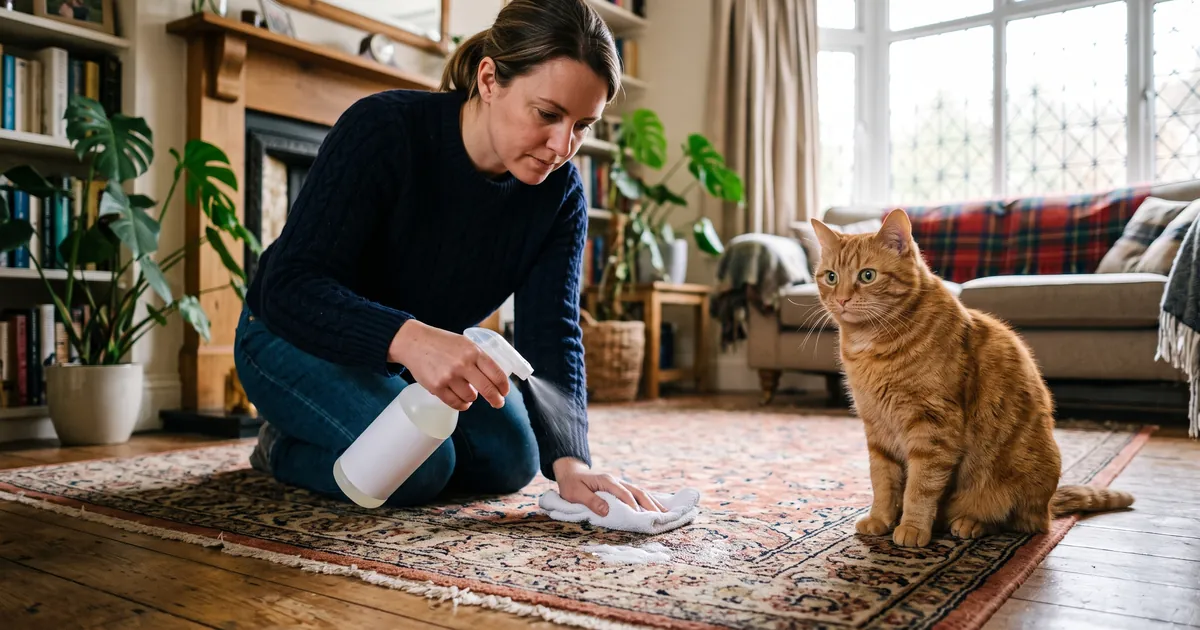
- Blot, don't rub. Press thick paper towels or an old towel firmly onto the spot, standing on it to soak up as much as possible. Repeat with fresh towels.
- Rinse with cold water (hot water can set the stain and smell) and blot again.
- Apply an enzyme cleaner generously. The cleaner must reach everywhere the urine went, often a much larger area in the underlay than on the surface.
- Leave it to work for the time on the label. Enzymes need time and moisture; covering the area loosely with cling film can help.
- Let it dry naturally, which can take 24 to 48 hours. Keep your cat away from the area while it dries.
- Repeat if needed. If any smell remains once fully dry, apply again.
For old stains, the urine may have soaked through to the underlay or floorboards. Severe or repeated soiling sometimes means the underlay needs replacing.
Enzyme cleaners: why they work
Enzyme (biological) cleaners contain enzymes and bacteria that break down the proteins and uric acid crystals in urine into harmless substances. Unlike perfumed sprays, they remove the source of the smell rather than covering it up, so cats are less likely to return to the same spot.
A traditional alternative recommended by some cat charities is to wash the area with a solution of biological washing powder (about one part powder to ten parts warm water), rinse with clean water, and allow to dry. Always test any product on a hidden patch first to check for colour fading.
Finding hidden stains
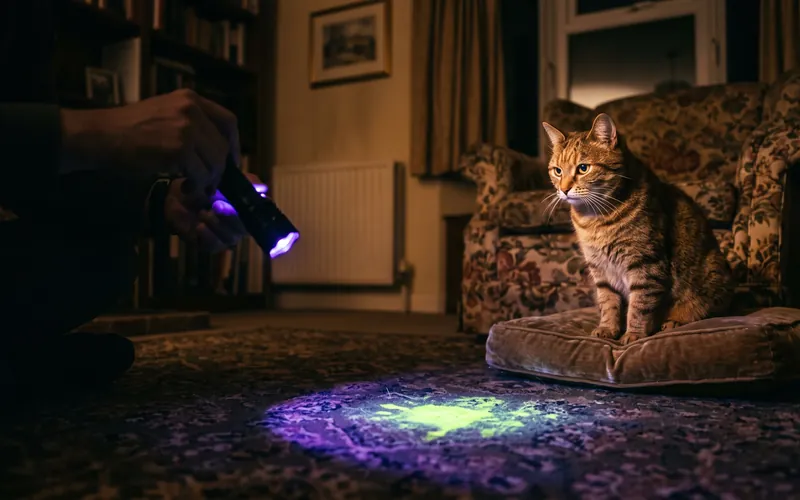
If you can smell urine but can't see the source, use a UV (blacklight) torch in a darkened room. Dried urine glows yellow-green under UV light. Check skirting boards, the corners of rooms, behind furniture, under beds, curtains, door frames and the sides of sofas. Mark each spot with masking tape so you can treat them all.
Removing cat urine smell from different surfaces
| Surface | Best approach |
|---|---|
| Rugs | Blot, then wash in the machine at 30–40°C with biological detergent if the care label allows; otherwise treat like carpet |
| Sofas and cushions | Blot, apply enzyme cleaner into the foam if possible; remove and wash covers; professional upholstery cleaning for bad cases |
| Mattresses | Blot, apply enzyme cleaner, cover with a towel, then air-dry thoroughly; use a waterproof protector afterwards |
| Bedding and clothes | Rinse in cold water, then wash with biological detergent; add an enzyme laundry additive |
| Hard floors and laminate | Wipe up, clean with enzyme cleaner and dry; check under laminate edges, where urine can seep |
| Grout and tiles | Enzyme cleaner and a stiff brush; resealing grout prevents future soaking |
| Walls and skirting boards (spraying) | Enzyme cleaner, then dry; washable paint may need repainting in severe cases |
| Car seats and carriers | Remove and wash fabric, enzyme-clean the rest, air-dry fully |
What not to use
- Ammonia-based cleaners: urine contains ammonia, so these smells can attract cats back to the spot.
- Bleach: it can damage fabrics and, mixed with ammonia or urine, releases harmful fumes. Never mix cleaning products.
- Strongly perfumed sprays and air fresheners: they mask the smell for you but not for your cat, and some (including essential oil diffusers) can be harmful to cats.
- Steam cleaners on fresh urine: heat can bind the proteins into fibres and set the smell.
Stopping your cat peeing in the same place
- Clean thoroughly with an enzyme cleaner, so no scent remains.
- Temporarily cover the area with foil, a plastic sheet or furniture, or put a food bowl there (cats rarely toilet where they eat).
- Place a litter tray near the spot, then move it gradually to where you want it.
- Make the area pleasant: a bed or scratcher placed there can change how your cat uses it.
Why cats pee outside the litter tray
Medical reasons
Always rule out illness first, especially if the behaviour is new:
- Cystitis (often stress-related) and urinary infections.
- Bladder stones or crystals.
- Kidney disease, diabetes and hyperthyroidism, which increase urine volume.
- Arthritis, making it painful to climb into a high-sided tray.
If your cat is straining with little or no urine, crying in the tray, or licking its genitals a lot, it may have a urinary blockage, which is a life-threatening emergency, especially in male cats. Go to a vet straight away.
Litter tray problems
- Not enough trays: the rule is one per cat, plus one.
- Dirty trays: scoop at least once a day.
- A litter your cat dislikes, often scented litter.
- Trays in noisy, busy places, or next to food.
- Covered trays that trap smells, or trays too small for large cats.
Spraying and stress
Spraying (marking vertical surfaces with small amounts of urine) is usually territorial. Triggers include unneutered status, other cats in the home or outside, a house move, building work or a new baby. Reducing stress, neutering and blocking views of outside cats can help. Read our guides to cat calming products and helping a cat settle after moving.
How to remove cat urine smell from a whole room
If a room has been used repeatedly, for example by a cat that sprayed before being neutered or a previous owner's pets in a new home, a few extra steps help:
- Find every spot with a UV torch and mark them.
- Clean each spot with an enzyme cleaner, working from the outside of the stain inwards.
- Wash curtains, cushion covers and throws.
- Ventilate the room well while everything dries.
- For heavily soaked carpets, have them professionally cleaned with an enzyme treatment, or replace the underlay.
- Seal stained floorboards or concrete with an odour-blocking primer before laying new flooring.
Moving into a home where previous pets have soiled can trigger marking in your own cat, so treat any smells before your cat arrives. Our guide to keeping a cat in after moving explains how to set up a safe first room.
Elderly cats and accidents
Older cats are more likely to have accidents because of arthritis, kidney disease, diabetes, hyperthyroidism or cognitive decline. Provide low-sided trays on every floor, put puppy pads or washable mats around trays, and book a senior health check. Treating pain often solves the problem: see our guide to arthritis pain relief for cats, and for kidney health our guide to renal diets for cats.
Cat peeing on the bed
Peeing on beds is distressing for owners but common. Beds are soft, absorbent and smell strongly of you, which may comfort an anxious cat. It's often linked to stress, conflict with another cat, or a medical problem. Wash bedding with biological detergent, use a waterproof protector, keep the bedroom door closed for a while, check the litter trays and book a vet check.
FAQs
What is the best way to remove cat urine smell from carpet?
Blot up as much urine as possible with paper towels, rinse the area with cold water and blot again, then soak it thoroughly with an enzyme cleaner, making sure it reaches the underlay. Leave it for the time on the label and let it dry naturally. Repeat if any smell remains once dry.
Why does cat urine smell come back?
Cat urine contains uric acid, which forms crystals that ordinary cleaners don't dissolve. When the area gets damp or humid, the crystals release the smell again. Enzyme cleaners break the uric acid down so the smell doesn't return.
Does vinegar remove cat urine smell?
A diluted vinegar solution can help neutralise some of the smell and is better than ammonia-based cleaners, but it doesn't break down uric acid as effectively as an enzyme cleaner. It's best used for fresh, small accidents, followed by an enzyme product.
How do I get cat urine smell out of a mattress?
Blot immediately, then spray with an enzyme cleaner and let it soak in. Cover with a towel and leave it to work, then let the mattress air-dry completely, ideally in sunlight or with a fan. A waterproof mattress protector prevents future soaking.
How do I find old cat urine stains?
Use a UV (blacklight) torch in a dark room. Dried urine glows a yellow-green colour, making it easy to find stains you can't see in normal light.
Why is my cat peeing outside the litter tray?
Common reasons include cystitis, urinary infections, kidney disease, diabetes, arthritis, a dirty or unsuitable litter tray, stress and territorial spraying. A sudden change always needs a vet check, especially if your cat is straining.
Sources and further reading
This guide is for general information only and is not a substitute for advice from a vet. Medicines, doses and costs change: always follow your vet and the product leaflet. If your cat is unwell or you think it has eaten something toxic, contact your vet or an emergency vet straight away.