What colours can cats see? Cat colour vision explained
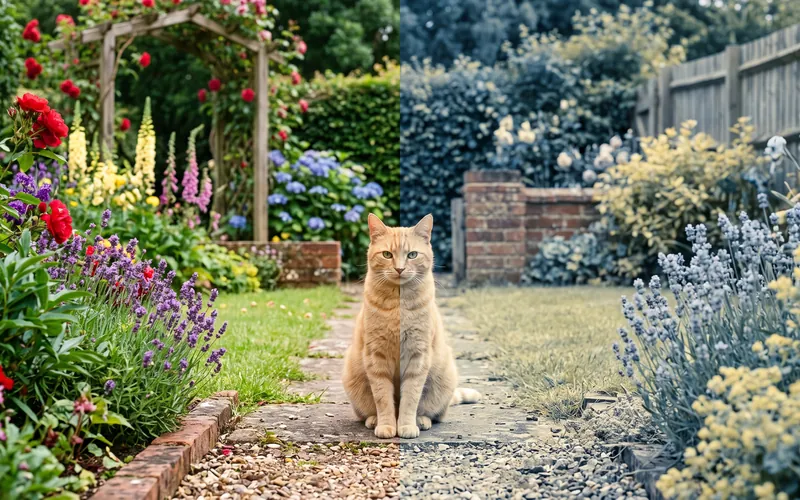
What colours can cats see? Cats aren't completely colour-blind, but they see a narrower range than we do. They see blues and yellows quite well, while reds, oranges and pinks look muted, greyish or similar to greens. In return, cats are far better than us at seeing movement and seeing in dim light. Here's how cat colour vision works and what it means for choosing toys.
Quick answer
- Cats have two types of colour cone (dichromatic vision), while people have three.
- They see blues and yellows best; reds and pinks look grey or brownish.
- Cats see movement and contrast far better than colour.
- Choose blue or yellow toys that contrast with your floor.
How cats see colour
Colour vision depends on cells in the retina called cones. People usually have three types of cone, sensitive to blue, green and red light, which lets us see millions of colours. Cats have mainly two types:
- One sensitive to blue-violet light.
- One sensitive to yellow-green light.
This is called dichromatic vision. Cats also have far fewer cones than we do and many more rods, which detect dim light and movement but not colour. That's why cats see colours as more washed-out and pastel than we do, but see much better in low light. Read more in our guide to whether cats can see in the dark.
What colours can cats see? A simple guide
| Colour (to us) | How a cat probably sees it |
|---|---|
| Blue | Clearly visible, slightly muted blue |
| Purple / violet | Bluish |
| Yellow | Clearly visible, pale yellow |
| Green | Yellowish or greyish |
| Red | Dark grey, brownish or similar to green |
| Orange | Yellowish-grey |
| Pink | Greyish |
| White, black and grey | Seen normally, with strong contrast |
These are best estimates from studies of cats' eyes and behaviour. We can't know exactly what colours look like to a cat, but the general pattern is well established.
Do cats see the colour red?
Cats likely can't tell red apart from green or grey. A red ball on a green lawn may be almost invisible to a cat unless it moves. Red laser pointers still grab cats' attention because the dot is bright, small and darting, which triggers the hunting instinct, rather than because of its colour.
Cats see movement better than colour
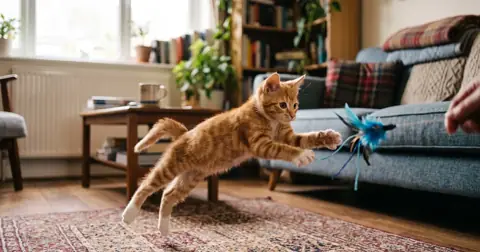
Colour matters much less to cats than movement and contrast. Cats' eyes and brains are tuned to detect tiny movements, especially at the edges of their vision, which helps them spot a mouse in the grass. They also detect flicker better than we do. That's why a still toy often gets ignored, while the same toy twitching on a string is irresistible.
Cats' vision is also less sharp than ours. They're slightly short-sighted and can't focus well on objects closer than about 30 cm, relying on their whiskers to find things right under their nose.
Can cats see ultraviolet light?
A study of mammal eyes published in 2014 found that cats' lenses let through more ultraviolet (UV) light than human lenses, suggesting cats may be able to see some UV. This could help them notice things invisible to us, such as urine trails, some patterns on prey or certain fibres. It may also explain why cats sometimes react to things we can't see. Research is still ongoing.
How colour vision affects your cat's toys
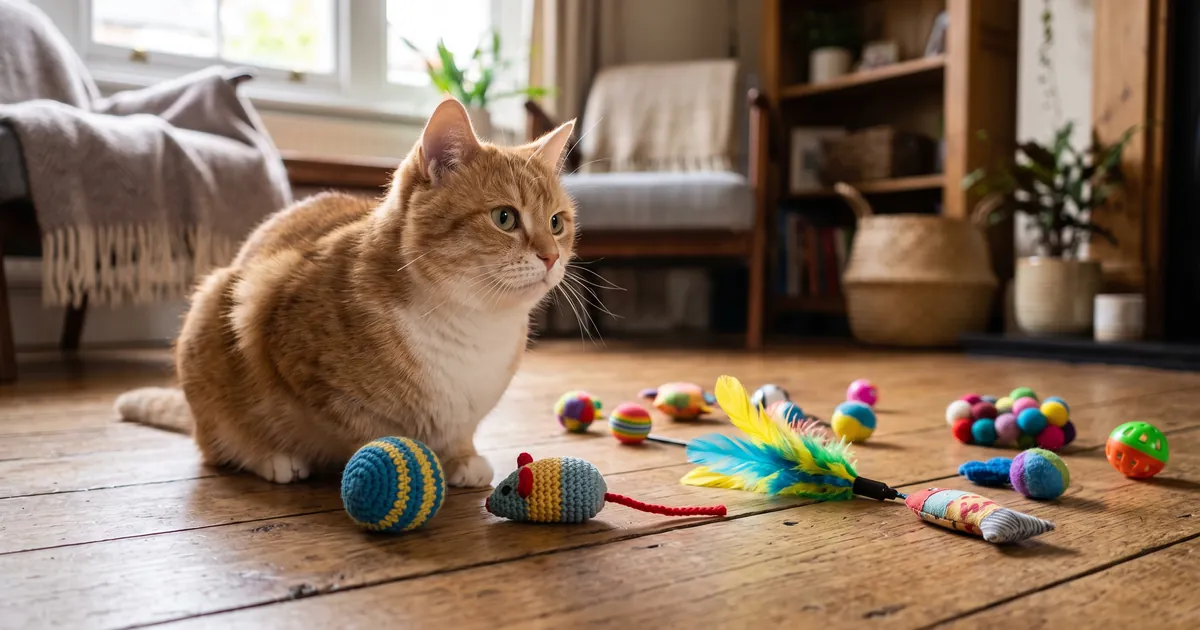
Pet shops often sell red and pink toys because people like them, but cats may struggle to see them, especially on carpet or grass. To make toys more visible:
- Choose blue or yellow toys, the colours cats see best.
- Pick toys that contrast with your floor: a blue toy on a beige carpet, or a yellow ball on dark wood.
- Use movement: wand toys, feathers and crinkly balls that roll unpredictably.
- Add sound and scent: bells, crinkle material, catnip or silvervine.
- Finish laser games with a physical toy your cat can catch, to avoid frustration.
- Rotate toys every week or so; novelty is often more exciting to a cat than any colour.
Plenty of play is important for every cat. Our guide to whether cats can have ADHD includes a daily enrichment plan.
Cats' colour vision vs dogs' and humans'
| Cats | Dogs | People | |
|---|---|---|---|
| Cone types | 2 (blue, yellow-green) | 2 (blue, yellow) | 3 (blue, green, red) |
| Colours seen best | Blues and yellows | Blues and yellows | Full spectrum |
| Reds | Greyish or brownish | Greyish or brownish | Vivid |
| Low-light vision | Excellent | Very good | Poor |
| Motion detection | Excellent | Excellent | Good |
Cats and dogs see colour in a broadly similar way, though cats have more rods and excel at very low light.
Do cats see in black and white?
This is a common myth. For many years, people believed cats saw only in shades of grey. Studies in the 20th century showed cats can tell certain colours apart, particularly blues and yellows, although it took a lot of training for them to do so in experiments. It seems colour simply isn't very important to cats, compared with movement, brightness and shape. For a predator that hunts at dawn and dusk, spotting a twitch in the grass matters far more than telling red from green.
Can cats see colours in the dark?
In very dim light, the colour-sensing cones don't work well in any mammal. Cats switch to their sensitive rods, which see in shades of grey. So at night, your cat sees the world mainly in monochrome, but much more clearly than you would.
How do scientists know what colours cats see?
Researchers use two main approaches. The first is studying the eye itself: measuring which wavelengths of light the cone cells in a cat's retina respond to, and how much light passes through the lens. The second is behavioural testing, where cats are trained to choose a coloured panel for a food reward and researchers check which colours they can tell apart when brightness is carefully matched. Together, these studies show that cats can distinguish blues from yellows, but find reds and greens much harder.
Do kittens see colour?
Kittens open their eyes at around 7 to 14 days old, but their vision starts out blurry. Over the next few weeks the retina and brain mature, and by around 3 months kittens see much like adult cats, including the same blue-and-yellow colour range. All kittens are born with blue eyes, which usually change to their adult colour between about 6 and 12 weeks.
Bright colours help birds, not cats
Birds see colour extremely well, including ultraviolet, far better than cats. That's why brightly coloured collar covers can help reduce the number of birds cats catch: the bird spots the colourful collar and flies away sooner. The colour makes no difference to your cat's own vision. Our guide to whether cats kill rabbits and birds explains other ways to protect garden wildlife, and our guide to cat collars covers safe fitting.
Eye colour and vision
A cat's eye colour (the iris) doesn't affect which colours it can see. Blue-eyed white cats, however, are more likely to be deaf in one or both ears, due to genetics linked to the white coat. Some blue-eyed breeds, such as the Siamese, have different wiring of the visual pathways, which can cause a squint or reduced depth perception in some individuals. If your cat's eyes change colour or look cloudy, see our guide to cat eye problems.
Does colour matter for cat beds, bowls and litter?
Cats don't choose beds or bowls by colour, but contrast can still help. A pale bowl on a dark floor, or a dark bowl on a pale floor, is easier for an older cat with fading eyesight to find. Brightly coloured tape on the edge of steps can help partially sighted cats judge stairs. Litter tray colour doesn't matter to most cats, but light-coloured litter makes it easier for you to spot changes in urine, such as blood, which can be an early sign of a bladder problem.
FAQs
Are cats colour-blind?
Not completely. Cats have dichromatic vision, meaning they have two types of colour-sensing cone cells rather than the three people have. They can tell blues and yellows apart but struggle to distinguish reds and greens, similar to a common form of red-green colour blindness in people.
Do cats see the colour red?
Cats probably don't see red as we do. Red objects are likely to look dark grey, brown or similar to green. A red laser dot is still visible because it's bright and moving, not because of its colour.
What colour is easiest for cats to see?
Blue and yellow are the colours cats see most clearly. Toys in these colours, especially against a contrasting background, are easiest for cats to spot.
Can cats see ultraviolet light?
Research suggests cats may be able to see some ultraviolet light, because their lens lets more UV through than ours. This might help them see things invisible to us, such as urine marks, though more research is needed.
Do cats see in black and white?
No. That's an old myth. Cats see some colour, mainly blues and yellows, but the colours are less vivid than what people see.
Can cats see colours in the dark?
In dim light, cats rely mostly on their rod cells, which don't detect colour, so they see mainly shades of grey. People are the same in very low light.
Sources and further reading
This guide is for general information only and is not a substitute for advice from a vet. Medicines, doses and costs change: always follow your vet and the product leaflet. If your cat is unwell or you think it has eaten something toxic, contact your vet or an emergency vet straight away.