Can dogs get cat fleas? How fleas spread between pets
Yes, dogs can get cat fleas. In fact, the cat flea is the most common flea found on dogs in the UK. Fleas jump freely between cats, dogs and other furry pets, so if one animal has fleas, they all need treating, with products that are safe for each species.

Quick answer
- The cat flea (Ctenocephalides felis) is the most common flea on UK dogs as well as cats.
- Fleas move between pets and spend most of their life cycle in your home, not on the animal.
- Treat every cat, dog and rabbit at the same time, with a product licensed for each species.
- Never use dog flea treatments on cats: many contain permethrin, which is toxic to cats.
Can dogs get cat fleas? Yes, and they usually do
The name is misleading. The "cat flea", Ctenocephalides felis, isn't fussy about its host. It feeds on cats, dogs, rabbits, ferrets and even people, although it can only breed on furry animals. Surveys of fleas collected from UK dogs have found that the large majority are cat fleas, with true dog fleas much less common.
So when people ask "can a dog get cat fleas?", the answer is that most flea problems in UK dogs are cat flea problems. If you live with cats and dogs, a flea infestation is a household problem, not a single-pet problem. Our guide to flea treatment for cats covers the cat side in detail.
Dog fleas vs cat fleas: what's the difference?
| Cat flea (C. felis) | Dog flea (C. canis) | |
|---|---|---|
| How common in UK | Very common on cats and dogs | Less common; more often in rural dogs |
| Hosts | Cats, dogs, rabbits, ferrets; bites people | Mainly dogs; also cats; bites people |
| Appearance | Tiny, brown, flattened; looks almost identical | Very similar; differs in head shape under a microscope |
| Carries flea tapeworm | Yes | Yes |
| Treatment | Same products kill both | Same products kill both |
For practical purposes, it doesn't matter which species of flea your pets have. The treatment, home cleaning and prevention are the same.
How fleas spread between cats and dogs
Adult fleas spend most of their time on an animal, feeding and laying eggs. But the eggs don't stay there:
- Eggs fall off wherever your pets rest, sleep and walk: beds, sofas, carpets and the car.
- Larvae hatch and hide deep in carpets and cracks, feeding on flea dirt.
- Pupae form inside sticky cocoons that can wait for weeks or months.
- New adults hatch when they sense warmth, vibration and carbon dioxide, and jump onto the nearest animal, whether that's a cat, a dog or you.
Pets can also pick up fleas from other animals' environments: a neighbour's garden, a boarding kennel, or wildlife such as hedgehogs and foxes passing through your garden.

Signs your dog has cat fleas
- Scratching, nibbling or chewing, especially around the lower back, tail base and inner thighs.
- Red, scabby or hot spots on the skin.
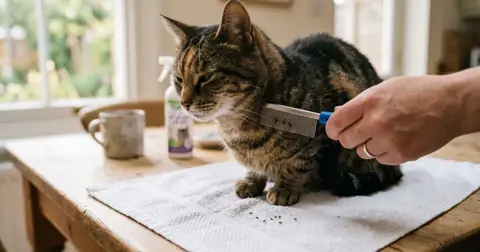
- Black specks of flea dirt in the coat, which turn red on damp paper.
- Hair loss from over-grooming.
- Tapeworm segments around the bottom.
- Bites on people in the home.
Comb your dog with a fine-toothed flea comb over a pale towel to check, just as you would a cat. Our guide to flea and worm treatment explains how to test flea dirt.
How to treat cats and dogs for fleas at the same time
- Treat every furry pet on the same day, using a product licensed for that species and weight.
- Keep treated pets apart until spot-ons are completely dry, especially if the dog's product contains permethrin.
- Wash all bedding at 60°C, including dog beds, cat beds, throws and the car blanket.
- Vacuum daily for two to three weeks and empty the vacuum outside.
- Use a household flea spray with an insect growth regulator in every room pets use. Follow the label and keep pets out until dry.
- Keep treating monthly (or as the product directs) for at least three months.
- Worm for tapeworm too: see our cat worming guide.
Why dog flea treatments are dangerous to cats
Many dog spot-ons, and some dog collars and shampoos, contain permethrin or related pyrethroids. Cats can't break down permethrin properly. A cat can be poisoned by being treated with a dog product by mistake, by grooming a recently treated dog, or by sleeping against it. Signs include twitching, trembling, wobbliness, drooling, dilated pupils and seizures, often within hours. This is an emergency: wash the area with washing-up liquid and warm water if possible and go to a vet immediately.
To stay safe:
- Check the label of every dog product for permethrin before using it in a home with cats.
- Keep cats away from treated dogs for at least 72 hours, or as the leaflet says.
- Store dog and cat products in different places so they can't be mixed up.
- If in doubt, ask your vet for a dog product that is safer to use around cats.
Products that treat cats and dogs (in separate doses)
Several brands make both cat and dog versions of their flea treatments, with different doses and sometimes different ingredients:
- Frontline: separate cat and dog products. Frontline Tri-Act is for dogs only and contains permethrin.
- Advantage: cat, dog and rabbit versions.
- Advocate and Bravecto: prescription cat and dog products in different strengths.
- Capstar: the same 11.4 mg tablet is licensed for cats and small dogs (1–11 kg).
Even when a brand makes both, never use the dog version on a cat.
Common situations: can dogs get cat fleas from…
Can dogs get cat fleas from sharing a bed or sofa?
Yes. Beds and sofas are where most flea eggs land, because pets spend hours resting there. A dog that naps where the cat sleeps will pick up newly hatched fleas within days. Wash shared bedding at 60°C and vacuum sofas thoroughly, including under the cushions.
Can dogs get cat fleas from the garden?
They can. Flea larvae survive in shady, sheltered spots such as under decking, in sheds and beneath hedges, where cats, foxes and hedgehogs rest. A dog lying in those spots can collect fleas even if your own cat is treated. Keeping all pets on year-round prevention covers this.
Can a dog get cat fleas from a neighbour's cat?
Yes, if the neighbour's cat visits your garden or home. You can't treat other people's pets, which is another reason to keep your own animals protected all year.
Other pets: rabbits, ferrets and guinea pigs
Cat fleas will also live on rabbits and ferrets. Rabbits are especially at risk of complications, and some cat flea products, such as fipronil, are dangerous to rabbits. Ask your vet for a rabbit-safe treatment. Guinea pigs have their own lice and mites but can also pick up cat fleas.
Can cat fleas live on humans?
Cat fleas bite people, usually on the ankles and lower legs, leaving small, very itchy red bumps, often in clusters. But they can't live or breed on people, because we don't have fur for them to shelter in. Bites usually stop within a couple of weeks of treating all your pets and your home. If you keep getting bitten after a month, the home treatment may need repeating, or there may be another source, such as a neighbour's pet or wildlife in a shed.
Preventing fleas in a multi-pet home
- Keep every pet on year-round flea prevention; fleas breed indoors in winter.
- Use long-acting products or set one shared reminder date for all pets.
- Wash pet bedding regularly and vacuum often, especially in summer and autumn.
- Treat new pets and visiting animals before they share bedding.
- Check pets after kennels, catteries or holidays.
Some owners find a long-lasting collar the easiest way to keep a dog protected. Our guide to flea collars for cats explains which cat collars are safe and how to fit them, and your vet can advise on dog collars that are safe to use in a home with cats.
FAQs
Can cat fleas live on dogs?
Yes. Cat fleas live, feed and breed happily on dogs. Surveys of UK dogs have found that the large majority of fleas on dogs are actually cat fleas, rather than dog fleas.
Will cat fleas live on a dog and then come back to my cat?
Yes. Fleas lay eggs that drop off into the home wherever pets rest. New fleas then hatch and jump onto whichever animal passes by, so untreated dogs keep reinfesting cats and vice versa.
What is the difference between dog fleas and cat fleas?
Dog fleas (Ctenocephalides canis) and cat fleas (Ctenocephalides felis) are closely related species that look almost identical without a microscope. Both will feed on cats, dogs and people. In the UK, cat fleas are far more common on both cats and dogs.
Can I use my dog's flea treatment on my cat?
No. Many dog flea products contain permethrin, which can cause tremors, seizures and death in cats. Even doses of products that are safe for cats differ between dogs and cats. Always use a product licensed for the species and weight of each pet.
Can cat fleas live on humans?
Cat fleas will bite people, usually around the ankles, but they can't live and breed on humans. Treating your pets and home stops the bites.
Do I need to treat my dog if only my cat has fleas?
Yes. If one pet has fleas, assume they all do. Treating only the cat leaves the dog to keep the flea life cycle going in your home.
Sources and further reading
This guide is for general information only and is not a substitute for advice from a vet. Medicines, doses and costs change: always follow your vet and the product leaflet. If your cat is unwell or you think it has eaten something toxic, contact your vet or an emergency vet straight away.